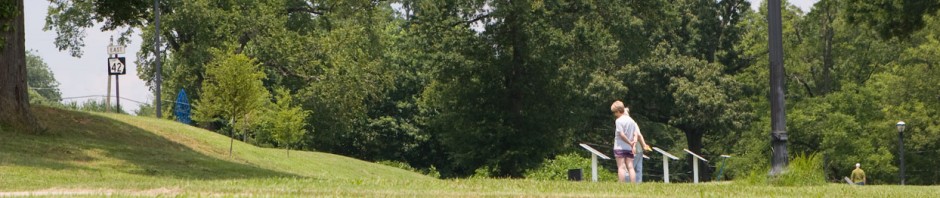

Freedom Park Entrance at Boulevard
Freedom Park represents one of the most significant achievements in urban land preservation in the United States during the 20th century. Its history spans more than a century of Atlanta’s past, from the Civil War, when General William T. Sherman watched the city burn, to the Civil Rights Movement, with the park bordering the birthplace of Dr. Martin Luther King, Jr., and into the modern era of grassroots activism. In the early 1990s, the neighborhood organization CAUTION successfully stopped a major Georgia Department of Transportation highway project, helping preserve Atlanta’s historic neighborhoods and create a lasting public green space.
The park emerged from an extraordinary, two-decade struggle by nine Atlanta neighborhoods to prevent the construction of several proposed highway systems. These projects threatened to divide historic communities and destroy a chain of parks designed by Frederick Law Olmsted. During the 1960s, the Georgia Department of Transportation demolished more than 500 homes for the proposed highway projects. In the years that followed, approximately 217 acres of land remained vacant and undeveloped, while the neighborhoods most affected continued their fight for preservation and the creation of parks within the city.
In 1982, CAUTION, Inc. was formed to oppose a proposed highway supported by prominent political leaders, including former U.S. President Jimmy Carter, Atlanta Mayor Andrew Young, a majority of the Atlanta City Council, and DeKalb County CEO Manuel Maloof. Despite this formidable opposition, neighborhood residents sustained years of legal battles, taking their case through the courts and ultimately to the Georgia Supreme Court. Their efforts also included protests, civil disobedience, and political organizing that helped elect more than 68 politicians who opposed the road.
With support from Congressman John Lewis and newly elected Atlanta Mayor Maynard Jackson, CAUTION ultimately succeeded in defeating plans for a four-lane expressway featuring bridges, high-speed traffic, trucks, and limited-access ramps. In 1991, the City of Atlanta, the Georgia Department of Transportation, and CAUTION reached a mediated resolution that led to the design and construction of Freedom Park and Freedom Parkway.
To learn more about this pivotal chapter in Atlanta’s history, watch Inman Park and the Road Fight, produced by Terminus Films.
Today, Freedom Park serves as both a vital urban green space and a living testament to the power of community activism. Freedom Parkway and Moreland Avenue bring an estimated 43,500 people through the park each day, connecting surrounding neighborhoods and providing a broad public audience for its landscape and art. Stretching nearly six miles and encompassing approximately 210 acres of rolling terrain, the park offers an expansive natural refuge within the city. Its open spaces welcome runners, walkers, bicyclists, and families while providing an important venue for public art and cultural expression in Atlanta.
Freedom Park is more than a park. It is the enduring result of a community’s determination to protect its neighborhoods, preserve its history, and ensure that future generations have access to open green space in the heart of Atlanta.

Freedom Park is located northeast of downtown Atlanta, extending along Freedom Parkway through some of the city’s oldest in-town neighborhoods. The park stretches from Boulevard to Ponce de Leon Avenue along its northern boundary and east toward Candler Park Drive. The National Park Service’s Martin Luther King, Jr. National Historical Park and Historic District border the park to the south, while the Jimmy Carter Presidential Library and Museum and the Carter Center are centrally located within its grounds.
Approximately six miles of PATH Foundation walking and biking trails connect downtown Atlanta to Freedom Park, winding through its rolling green spaces and historic surrounding neighborhoods. These trails provide a vital link between communities, offering residents and visitors opportunities for recreation, transportation, and exploration while showcasing Atlanta’s distinctive blend of history, culture, and urban nature